
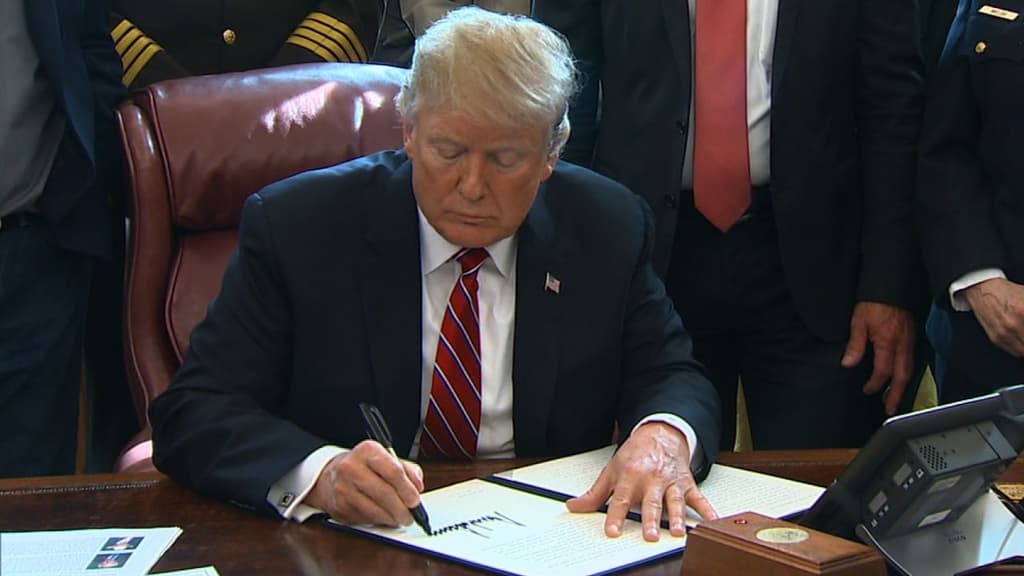
Trump has publicly left open the possibility of declaring a national emergency over alleged foreign election interference ahead of the November 2026 midterms, most recently responding “stranger things have happened” during an August 2026 interview when asked about using such powers to impose voter ID, proof of citizenship, and mail ballot limits if the SAVE America Act stalls in Congress. Allies have circulated draft executive orders since February 2026 citing unproven 2020 foreign interference claims to justify federal control over voting machines and mail ballots, while administration rhetoric has intensified around election security threats. The 2026 midterms remain the key near-term catalyst, though constitutional limits on presidential authority over elections and ongoing legal challenges create uncertainty around any declaration by year-end.
Polymarketデータを参照したAI生成の実験的な要約。これは取引アドバイスではなく、このマーケットの解決方法には一切関係ありません。 · 更新日$185,540 Vol.
12月31日
22%
$185,540 Vol.
12月31日
22%
A qualifying declaration must include formal language stating that a national emergency exists and must be issued under the National Emergencies Act (50 U.S.C. § 1621 et seq.). The declaration must explicitly reference interference in U.S. elections, election processes, election systems, voting procedures, ballots, or voting machines as the basis for the emergency. Statements, speeches, social media posts, draft orders, executive orders that do not formally declare a national emergency under the National Emergencies Act, or other actions that merely reference election interference without declaring a national emergency will not qualify.
Renewals or extensions of previously existing national emergencies will not qualify unless the text is materially modified to explicitly relate to election interference.
The primary resolution source will be the Federal Register and official White House publications, however a consensus of credible reporting may also be used.
マーケット開始日: Feb 26, 2026, 4:29 PM ET
Resolver
0x65070BE91...A qualifying declaration must include formal language stating that a national emergency exists and must be issued under the National Emergencies Act (50 U.S.C. § 1621 et seq.). The declaration must explicitly reference interference in U.S. elections, election processes, election systems, voting procedures, ballots, or voting machines as the basis for the emergency. Statements, speeches, social media posts, draft orders, executive orders that do not formally declare a national emergency under the National Emergencies Act, or other actions that merely reference election interference without declaring a national emergency will not qualify.
Renewals or extensions of previously existing national emergencies will not qualify unless the text is materially modified to explicitly relate to election interference.
The primary resolution source will be the Federal Register and official White House publications, however a consensus of credible reporting may also be used.
Resolver
0x65070BE91...Trump has publicly left open the possibility of declaring a national emergency over alleged foreign election interference ahead of the November 2026 midterms, most recently responding “stranger things have happened” during an August 2026 interview when asked about using such powers to impose voter ID, proof of citizenship, and mail ballot limits if the SAVE America Act stalls in Congress. Allies have circulated draft executive orders since February 2026 citing unproven 2020 foreign interference claims to justify federal control over voting machines and mail ballots, while administration rhetoric has intensified around election security threats. The 2026 midterms remain the key near-term catalyst, though constitutional limits on presidential authority over elections and ongoing legal challenges create uncertainty around any declaration by year-end.
Polymarketデータを参照したAI生成の実験的な要約。これは取引アドバイスではなく、このマーケットの解決方法には一切関係ありません。 · 更新日

外部リンクに注意してください。
外部リンクに注意してください。
よくある質問