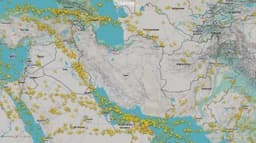
Ongoing military tensions between Iran, the United States, and Israel, including renewed exchanges near the Strait of Hormuz after the US-Iran ceasefire breakdown in June 2026, continue to shape expectations around potential full Iranian airspace closures. Iran closed the western portion of the Tehran FIR (OIIX) in early June amid missile launches and related security assessments, while the eastern section saw partial reopening for overflights; few international carriers operate through the region as a result. EASA maintains its CZIB advising complete avoidance of Iranian airspace through at least August 31, 2026, citing risks of misidentification and surface-to-air threats, though this reflects external advisories rather than Iranian-initiated full suspension. Trader sentiment reflects the distinction between these targeted or partial measures and the stricter criteria for a general, nationwide closure qualifying under market rules, alongside the absence of broader diplomatic de-escalation or major new escalatory triggers in recent weeks.
Ringkasan eksperimental yang dihasilkan AI dengan referensi data Polymarket. Ini bukan saran trading dan tidak berperan dalam bagaimana pasar ini diselesaikan. · DiperbaruiIran full airspace closure by...?
Iran full airspace closure by...?
$8,646,264 Vol.
August 31
2%
September 30
7%
December 31
19%
$8,646,264 Vol.
August 31
2%
September 30
7%
December 31
19%
A “general closure” refers to a cancellation or suspension of aviation which is generally applicable to all commercial flights transiting Iranian airspace (“Tehran FIR”). A qualifying closure must apply generally to all of Iran or the Tehran FIR; limited cancellations, delays, or partial closures will not qualify. A closure which applies generally to commercial aviation across Iranian airspace, with limited exceptions for certain categories of flights, however, will qualify (e.g. exceptions for certain flights pre-approved by the Iranian Civil Aviation Authority may be permitted).
Qualifying previous examples include the February 28, 2026 total closure of Iranian airspace (https://www.iranintl.com/en/202602289115) and the January 2026 total closure of Iranian airspace except to international flights with express governmental permission (https://www.reuters.com/world/middle-east/iran-shuts-airspace-most-flights-flightradar24-says-2026-01-14/). Non-qualifying examples include the January 27, 2026 partial closure of Iranian airspace around the Strait of Hormuz (https://www.aa.com.tr/en/middle-east/iran-issues-airspace-notice-for-military-drills-near-strait-of-hormuz/3812508), the April 2024 closure of Iran’s western airspace (https://www.reuters.com/world/middle-east/iranian-airports-cancel-flights-until-monday-morning-2024-04-14/), and the January 25 - April 25, 2026 VFR (Visual Flight Rules) flights suspension which did not broadly close commercial aviation in Iran (https://www.intellinews.com/iran-suspends-general-aviation-and-vfr-flights-in-new-airspace-directive-421997/).
Warnings, No-Fly-Zones, or other flight restrictions imposed by airlines or countries other than Iran will not be sufficient for a “Yes” resolution.
Airspace closures which occur solely due to weather conditions, earthquakes, or volcanic eruptions, will not qualify.
The primary resolution sources for this market will be official information from Iranian aviation authorities and a consensus of credible reporting.
Pasar Dibuka: Jul 27, 2026, 1:36 PM ET
Resolver
0x65070BE91...A “general closure” refers to a cancellation or suspension of aviation which is generally applicable to all commercial flights transiting Iranian airspace (“Tehran FIR”). A qualifying closure must apply generally to all of Iran or the Tehran FIR; limited cancellations, delays, or partial closures will not qualify. A closure which applies generally to commercial aviation across Iranian airspace, with limited exceptions for certain categories of flights, however, will qualify (e.g. exceptions for certain flights pre-approved by the Iranian Civil Aviation Authority may be permitted).
Qualifying previous examples include the February 28, 2026 total closure of Iranian airspace (https://www.iranintl.com/en/202602289115) and the January 2026 total closure of Iranian airspace except to international flights with express governmental permission (https://www.reuters.com/world/middle-east/iran-shuts-airspace-most-flights-flightradar24-says-2026-01-14/). Non-qualifying examples include the January 27, 2026 partial closure of Iranian airspace around the Strait of Hormuz (https://www.aa.com.tr/en/middle-east/iran-issues-airspace-notice-for-military-drills-near-strait-of-hormuz/3812508), the April 2024 closure of Iran’s western airspace (https://www.reuters.com/world/middle-east/iranian-airports-cancel-flights-until-monday-morning-2024-04-14/), and the January 25 - April 25, 2026 VFR (Visual Flight Rules) flights suspension which did not broadly close commercial aviation in Iran (https://www.intellinews.com/iran-suspends-general-aviation-and-vfr-flights-in-new-airspace-directive-421997/).
Warnings, No-Fly-Zones, or other flight restrictions imposed by airlines or countries other than Iran will not be sufficient for a “Yes” resolution.
Airspace closures which occur solely due to weather conditions, earthquakes, or volcanic eruptions, will not qualify.
The primary resolution sources for this market will be official information from Iranian aviation authorities and a consensus of credible reporting.
Resolver
0x65070BE91...Ongoing military tensions between Iran, the United States, and Israel, including renewed exchanges near the Strait of Hormuz after the US-Iran ceasefire breakdown in June 2026, continue to shape expectations around potential full Iranian airspace closures. Iran closed the western portion of the Tehran FIR (OIIX) in early June amid missile launches and related security assessments, while the eastern section saw partial reopening for overflights; few international carriers operate through the region as a result. EASA maintains its CZIB advising complete avoidance of Iranian airspace through at least August 31, 2026, citing risks of misidentification and surface-to-air threats, though this reflects external advisories rather than Iranian-initiated full suspension. Trader sentiment reflects the distinction between these targeted or partial measures and the stricter criteria for a general, nationwide closure qualifying under market rules, alongside the absence of broader diplomatic de-escalation or major new escalatory triggers in recent weeks.
Ringkasan eksperimental yang dihasilkan AI dengan referensi data Polymarket. Ini bukan saran trading dan tidak berperan dalam bagaimana pasar ini diselesaikan. · Diperbarui


Hati-hati dengan link eksternal.
Hati-hati dengan link eksternal.
Pertanyaan yang Sering Diajukan