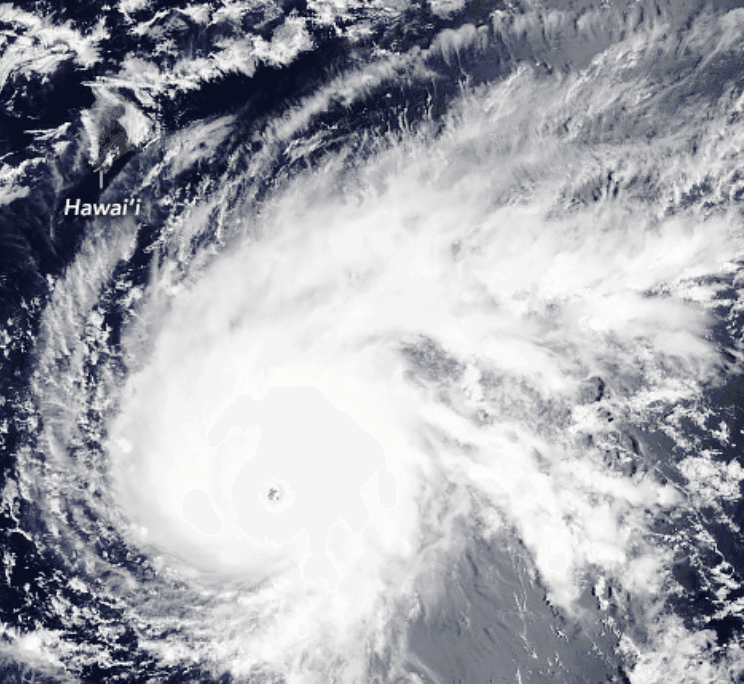
Hawaii's central Pacific location and prevailing trade wind patterns make direct hurricane landfalls exceptionally rare, supporting the 72.5% market-implied probability of "No" before 2027. Historical records show only two confirmed hurricane landfalls since 1950—Dot in 1959 and Iniki in 1992—with most central Pacific systems either weakening, recurving, or brushing the islands as tropical storms or depressions. NOAA's 2026 outlook forecasts an above-normal season with 5–13 cyclones amid El Niño conditions, yet steering currents and vertical wind shear typically prevent intensification to hurricane strength at landfall. Recent model guidance shows only low-probability threats through mid-August, consistent with climatological baselines where even active years rarely produce the specific track and intensity needed for resolution.
Експериментальне резюме, згенероване ШІ з посиланням на дані Polymarket. Це не торгова порада і не впливає на вирішення цього ринку. · ОновленоWill a hurricane make landfall in Hawaii before 2027?
Will a hurricane make landfall in Hawaii before 2027?
A hurricane is a tropical cyclone with maximum sustained winds of 74 mph or greater (Category 1 or higher on the Saffir-Simpson Hurricane Wind Scale), as described at https://www.nhc.noaa.gov/aboutsshws.php, and a hurricane landfall is said to occur when the hurricane's surface center intersects with the coastline, as described at https://www.nhc.noaa.gov/aboutgloss.shtml#LANDFALL. A storm must hold hurricane strength (Category 1 or higher on the Saffir-Simpson scale) at the moment its surface center intersects the coastline for that landfall to qualify.
"Hawaii" means the entire State of Hawaii as recognized under U.S. law, including the main Hawaiian Islands (Hawaiʻi, Maui, Oʻahu, Kauaʻi, Molokaʻi, Lānaʻi, Niʻihau, and Kahoʻolawe) and the Northwestern Hawaiian Islands (including Midway Atoll and the Papahānaumokuākea Marine National Monument).
The wind speed at the moment of landfall will be determined from the CPHC advisory or Special Advisory in effect at the time closest to the reported landfall time; where no advisory covers that exact moment, the most recent advisory issued prior to landfall governs.
This market may resolve based on the initial CPHC advisory reporting a qualifying landfall regardless of any later advisory, retraction, best-track revision, or reanalysis that revises that storm's intensity downward at the time of landfall. However, if a subsequent advisory or correction identifies a qualifying landfall that was not reflected in initial reporting, this market will resolve to "Yes" based on that correction.
Ринок відкрито: Jul 24, 2026, 11:28 AM ET
Resolver
0x65070BE91...A hurricane is a tropical cyclone with maximum sustained winds of 74 mph or greater (Category 1 or higher on the Saffir-Simpson Hurricane Wind Scale), as described at https://www.nhc.noaa.gov/aboutsshws.php, and a hurricane landfall is said to occur when the hurricane's surface center intersects with the coastline, as described at https://www.nhc.noaa.gov/aboutgloss.shtml#LANDFALL. A storm must hold hurricane strength (Category 1 or higher on the Saffir-Simpson scale) at the moment its surface center intersects the coastline for that landfall to qualify.
"Hawaii" means the entire State of Hawaii as recognized under U.S. law, including the main Hawaiian Islands (Hawaiʻi, Maui, Oʻahu, Kauaʻi, Molokaʻi, Lānaʻi, Niʻihau, and Kahoʻolawe) and the Northwestern Hawaiian Islands (including Midway Atoll and the Papahānaumokuākea Marine National Monument).
The wind speed at the moment of landfall will be determined from the CPHC advisory or Special Advisory in effect at the time closest to the reported landfall time; where no advisory covers that exact moment, the most recent advisory issued prior to landfall governs.
This market may resolve based on the initial CPHC advisory reporting a qualifying landfall regardless of any later advisory, retraction, best-track revision, or reanalysis that revises that storm's intensity downward at the time of landfall. However, if a subsequent advisory or correction identifies a qualifying landfall that was not reflected in initial reporting, this market will resolve to "Yes" based on that correction.
Resolver
0x65070BE91...Hawaii's central Pacific location and prevailing trade wind patterns make direct hurricane landfalls exceptionally rare, supporting the 72.5% market-implied probability of "No" before 2027. Historical records show only two confirmed hurricane landfalls since 1950—Dot in 1959 and Iniki in 1992—with most central Pacific systems either weakening, recurving, or brushing the islands as tropical storms or depressions. NOAA's 2026 outlook forecasts an above-normal season with 5–13 cyclones amid El Niño conditions, yet steering currents and vertical wind shear typically prevent intensification to hurricane strength at landfall. Recent model guidance shows only low-probability threats through mid-August, consistent with climatological baselines where even active years rarely produce the specific track and intensity needed for resolution.
Експериментальне резюме, згенероване ШІ з посиланням на дані Polymarket. Це не торгова порада і не впливає на вирішення цього ринку. · Оновлено

Обережно з зовнішніми посиланнями.
Обережно з зовнішніми посиланнями.
Часті запитання