
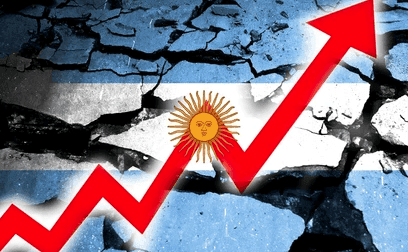
**Argentina’s official USD/ARS rate has stabilized near 1,490–1,500 as of mid-August 2026 after rising gradually through a managed crawling-band regime introduced in January.** Under President Milei, the band now widens monthly in line with lagged inflation (recently around 2%), while the central bank prioritizes daily FX purchases to rebuild reserves and support external debt service. With annual inflation having fallen sharply to the low-30% range and fiscal balance maintained, the market-implied path of roughly 1–2% monthly depreciation through year-end keeps the <1,600 bracket the clear leader at 43% probability, followed by the 1,600–1,700 range at 32.5%. Traders assign low weight to sharper moves because reserve-accumulation targets and the absence of acute external shocks reinforce the gradual-adjustment framework, though proximity to the 2027 elections and any slippage in reserve or inflation progress remain the key swing factors for the final months of 2026.
Résumé expérimental généré par IA à partir des données Polymarket. Ceci n'est pas un conseil de trading et ne joue aucun rôle dans la résolution de ce marché. · Mis à jour$21,601 Vol.
$21,601 Vol.
<1600,00
43%
1600,00–1699,99
33%
1700,00–1799,99
8%
1800,00–1899,99
6%
1900,00–1999,99
1%
2000,00+
3%
$21,601 Vol.
$21,601 Vol.
<1600,00
43%
1600,00–1699,99
33%
1700,00–1799,99
8%
1800,00–1899,99
6%
1900,00–1999,99
1%
2000,00+
3%
This market will resolve according to the official wholesale USD to ARS exchange rate (Tipo de Cambio Mayorista, ($ por USD) Com. A 3500 | Referencia) at market close on the final business day of December 2026, as published by the BCRA on its official website (https://www.bcra.gob.ar/).
If the official rate for that date has not been published by the end of the 7th day after the end of the specified month, the market will resolve according to the most recently published official wholesale rate preceding that date.
The resolution source for this market will be the official BCRA publication. Resolution will occur once this figure is available.
Note: the resolution source for this market will be the Central Bank of Argentina (BCRA), which reports the Wholesale Exchange Rate to two decimal points (e.g., 1,408.02 ARS per USD). Thus, this is the level of precision that will be used when resolving the market.
Marché ouvert : Jan 26, 2026, 4:48 PM ET
Resolver
0x2F5e3684c...This market will resolve according to the official wholesale USD to ARS exchange rate (Tipo de Cambio Mayorista, ($ por USD) Com. A 3500 | Referencia) at market close on the final business day of December 2026, as published by the BCRA on its official website (https://www.bcra.gob.ar/).
If the official rate for that date has not been published by the end of the 7th day after the end of the specified month, the market will resolve according to the most recently published official wholesale rate preceding that date.
The resolution source for this market will be the official BCRA publication. Resolution will occur once this figure is available.
Note: the resolution source for this market will be the Central Bank of Argentina (BCRA), which reports the Wholesale Exchange Rate to two decimal points (e.g., 1,408.02 ARS per USD). Thus, this is the level of precision that will be used when resolving the market.
Resolver
0x2F5e3684c...**Argentina’s official USD/ARS rate has stabilized near 1,490–1,500 as of mid-August 2026 after rising gradually through a managed crawling-band regime introduced in January.** Under President Milei, the band now widens monthly in line with lagged inflation (recently around 2%), while the central bank prioritizes daily FX purchases to rebuild reserves and support external debt service. With annual inflation having fallen sharply to the low-30% range and fiscal balance maintained, the market-implied path of roughly 1–2% monthly depreciation through year-end keeps the <1,600 bracket the clear leader at 43% probability, followed by the 1,600–1,700 range at 32.5%. Traders assign low weight to sharper moves because reserve-accumulation targets and the absence of acute external shocks reinforce the gradual-adjustment framework, though proximity to the 2027 elections and any slippage in reserve or inflation progress remain the key swing factors for the final months of 2026.
Résumé expérimental généré par IA à partir des données Polymarket. Ceci n'est pas un conseil de trading et ne joue aucun rôle dans la résolution de ce marché. · Mis à jour
Méfiez-vous des liens externes.
Méfiez-vous des liens externes.
Questions fréquentes